
Most podcasts, books, and TED talks about learning give you the same advice: if you want to get better, get feedback.
It’s good advice. It’s also the easy part. Feedback is everywhere — film yourself, read the room, or just ask for it. The hard part is making the feedback useful.
Right now my algorithm is full of three things: fans from different countries partying at the World Cup, millennials arguing the early 2000s was the best era of hip-hop, and people panning for gold.
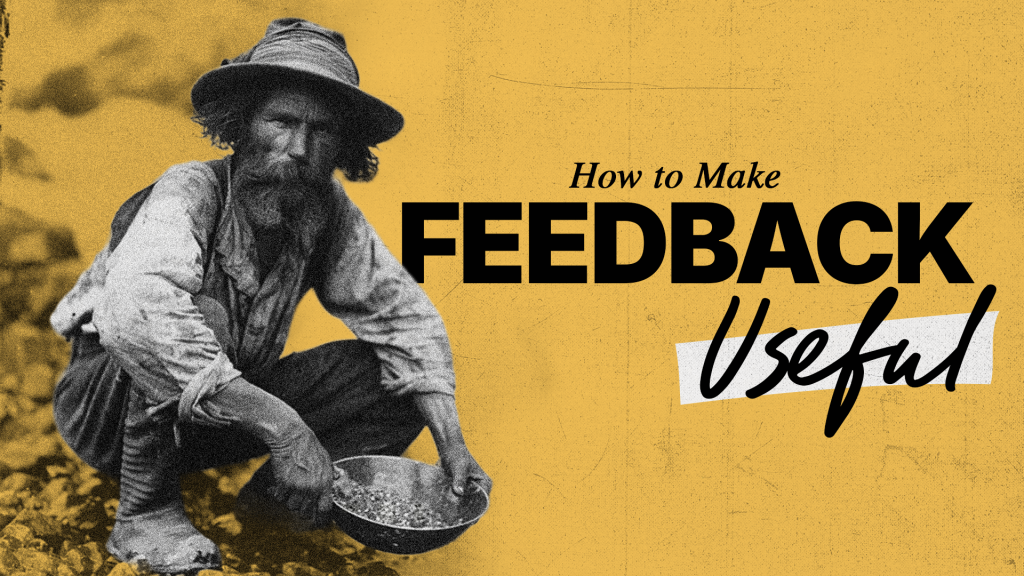
The panning-for-gold clips get me every time. Someone crouches in a freezing river, scoops up a pan full of muck — dirt, gravel, sand — and starts swirling. They rinse and tip and swirl again. Most of what they scooped washes away. More swirling, more rinsing, until finally, if they’re lucky: a few tiny flecks of gold at the bottom of the pan.
This is like feedback. Getting it is easy — it’s all around us, like dirt in the riverbed. The real work is filtering the pan for the few flecks worth keeping. Some feedback is signal, some is noise. Some is gold, some is dirt. The goal isn’t to accept all of it. It’s to find the value buried in it.
Here are three ways to do that:
1. Make It Actionable
A lot of the feedback we get isn’t that helpful. What determines quality isn’t whether it’s positive or negative. It’s whether it’s useful. And most feedback is too general to be useful: “That was good.” “That was bad.” One feels nice, one stings, but neither tells you what to do next.
Some feedback is even harmful. Kluger & DeNisi conducted a meta-analysis pooling hundreds of feedback interventions and found that nearly 40% of them actually hurt future performance. When the feedback focused on the person: “You’re good,” “You’re bad,” “You’re a natural,” “You’re not cut out for this” performance suffered or didn’t improve. The feedback that helped focused on the task: what made it good, what made it bad, what progress was made, what to fix next time.
How do we avoid general or hurtful feedback? Stop asking for feedback and start asking for advice instead.
Research shows that this small shift makes a big difference. When we ask for feedback: “How did that go?” “What did you think?” we get general responses, or the self-focused kind that hurts.
When we ask for advice: “What would make this better next time?” the answer changes. Advice takes the focus off the person and puts it on the task. It comes back more actionable, more concrete, more forward-looking.
2. Pick the Right Source
I’m writing a book. Early on, I sent draft chapters to dozens of people — I was hungry for feedback and wanted as much as I could get. But when I sat down to use it, it was impossible: readers were arguing for and against the exact same things. So I got strategic about who I asked, depending on what I needed.
I found someone who was great at sharpening my storytelling. Researchers and experts were perfect for accuracy. And total novices — people who knew nothing about the topic — turned out to be my best source for clarity. They couldn’t fake understanding, so they told me exactly where they got lost.
So as you filter, weigh the source, the context, and the motive. As Warren Buffett put it: “Never ask a barber if you need a haircut.”
Which brings us to AI. There are ways to get useful feedback from a model, but be careful — a lot of them are tuned to make you feel good, not to make your work better. I’ve had luck saying so directly in the prompt: I want your honest feedback. Don’t worry about making me feel good. I’d rather improve this than feel good about it.
3. Look for Patterns
I once asked a comedian how she processed feedback from the audience. I figured it was simple: if they laugh, the joke works; if they don’t laugh, it doesn’t. She said it took her years to stop thinking that way. Early on, if a joke didn’t land, she’d cut it that night. Now, if a joke bombs, she holds onto it — she’ll run it a few more times, tweak the wording, the timing and the setup before she decides it’s actually dead. And she said eventually she finds something that works.
One bad performance isn’t a pattern — it’s a single data point, and the discipline is waiting before you act. But notice what she does while she waits: she doesn’t repeat the exact joke, she tests it — new wording, new timing, new setup. She trusts that it bombed. But she’s looking for exactly why.
People are better at spotting where something’s wrong than how to fix it. If we’re getting feedback pointing at the same issue we can trust there’s a problem. Then it’s on us to figure out how to fix it.
When we’re processing feedback we need to steal this approach. Be patient and look for patterns. If one person trips over a spot in your talk or sales pitch, pay attention but keep going. If fifteen people trip over the same spot, pay even closer attention because the spot is likely broken. When we receive similar feedback from a variety of sources, it’s worth exploring—even if we feel a little salty about it.
Feedback isn’t a verdict to accept or an order to obey — it’s information you learn to interpret. The best learners stay open without being gullible, and skeptical without being defensive. They know the river is full of dirt, and that there might be gold in the pan. So they keep swirling.