I’m in an auditorium at a high school in Colorado. In five minutes I’m going to give a talk to a few hundred students. I’m watching everyone file in when I notice three boys heading for the very back row. I know these guys right away. They’re the ones who get labeled “troublemakers,” but really they’d just rather be anywhere other than a boring school assembly. I’m not offended. I did the same thing at their age.
Before they make it to the last row, a teacher cuts them off and sends them to the front. They slouch down in their chairs and fold their arms across their chests.
The talk is about growth mindset—why it’s important to believe that we can learn.
I glance at the boys throughout the talk. Two of them sit up a little when I share quotes from LeBron James. That’s good timing, because we’re about to get to the best part. It’s the piece of growth mindset that doesn’t get enough attention: how to actually build one.
“A good way to build your growth mindset,” I say, “is to remember the skills you’ve built in the past.”
The boys scrunch up their faces, a little confused.
“Thirty seconds on the clock. Turn to the person next to you and share two things you’re good at.”
There’s a brief pause, and then the boys, along with the rest of the students, turn to each other and start talking. I can’t hear what they’re saying, but their eyes are big and their faces are animated. They’re sharing all sorts of things they’re good at.
I’ve done this exercise with students in Colorado and government employees in Sacramento, and it always goes the same way. Everyone eventually thinks of a couple things they’re good at.
What would your two skills be?
In ten seconds you probably thought of a couple. And if you give yourself credit you could identify many more. And all of those skills have something in common: once upon a time, you weren’t as good at them as you are now. You got better by doing them, through trial and error and practice. You weren’t just born with those skills. You built them.
That’s the point of the exercise. It gives us concrete evidence that we’re capable of learning—a reason to believe we can keep getting better.
I believe I can learn stuff, because I have learned stuff.
At the end of the hour, the students shuffle back to class, except for one of the boys from the front row. He’s hanging back with his hands in his pockets. I can tell he wants to say something, so I walk over.
“Hey,” he says. “I just wanted to say that I really liked the talk. I’ve never thought about learning like that before, like it’s something I’m already good at. It was really cool.”
Hearing this feels good, but the look on his face is the best part. It’s the look of someone who just realized he’s a learner.
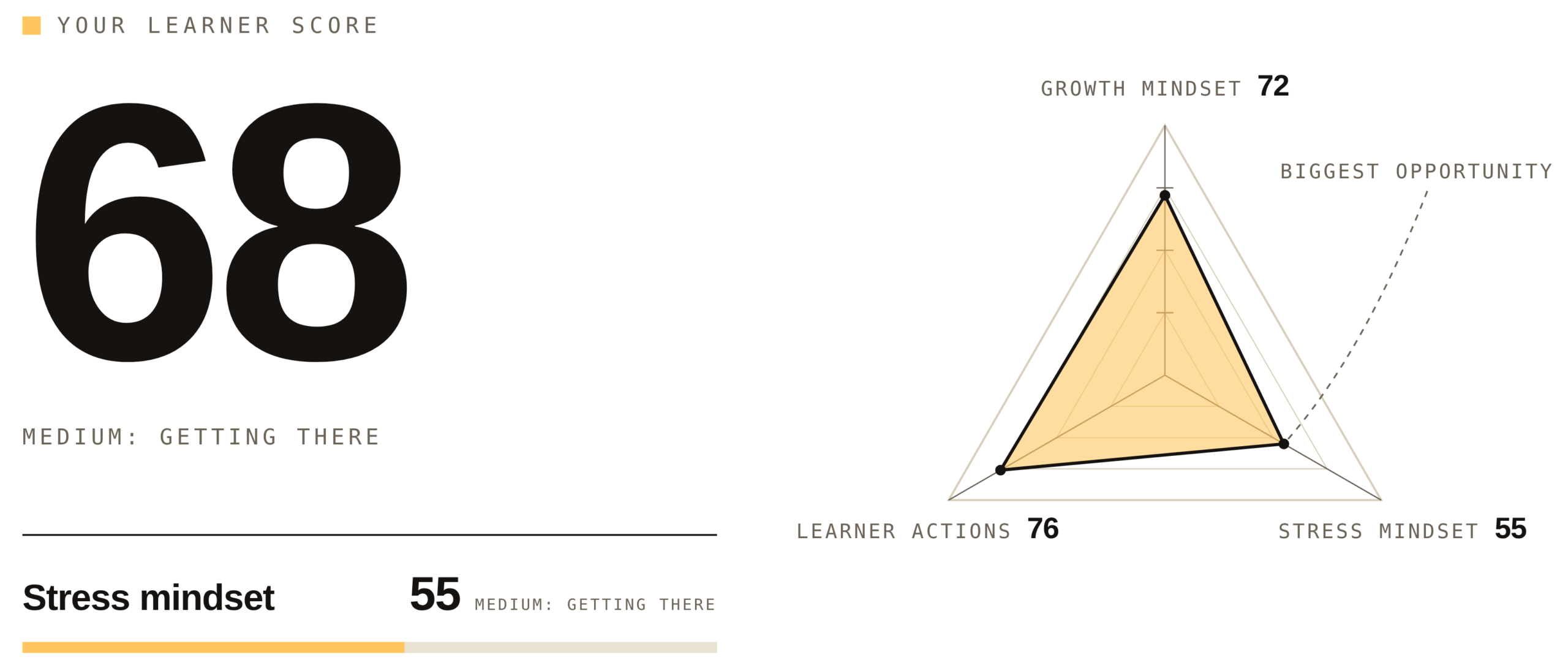
Measure Your Growth Mindset
We built a free assessment that measures your growth mindset and other mindsets and habits related to learning. It takes about three minutes. You’ll receive a full report, plus resources to help you improve in the areas you need it most: